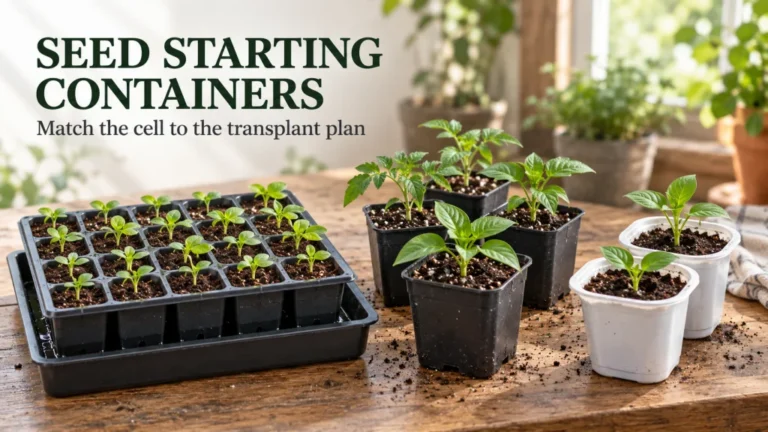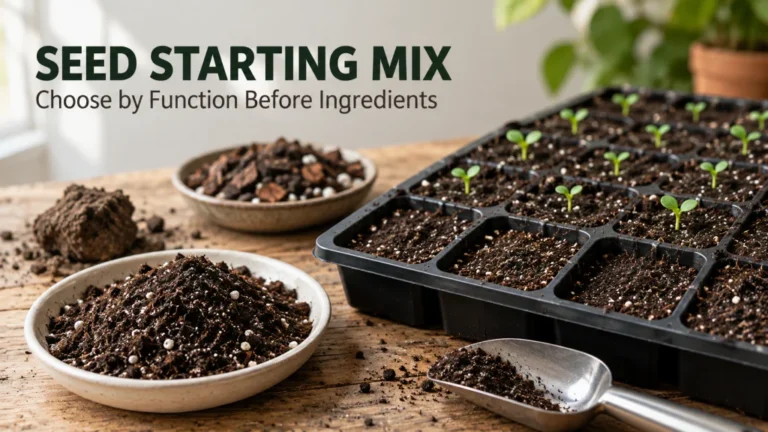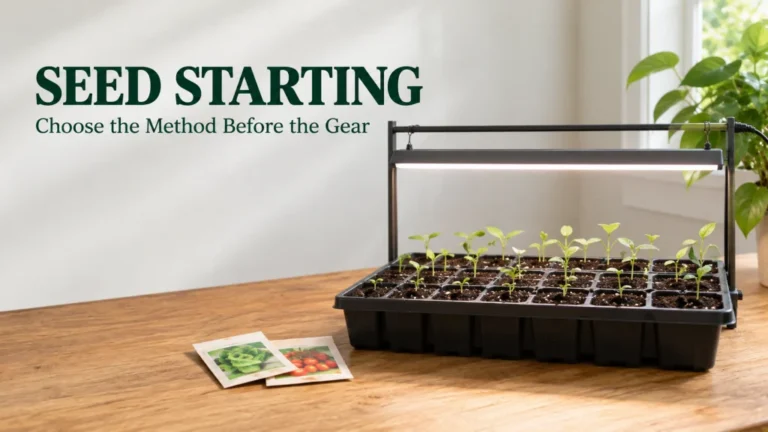
Knowing when to start seeds indoors is mostly a backward-scheduling problem, not a race to sow as early as possible. Start with the outdoor event named by your seed packet or trusted growing guidance, subtract the recommended indoor growing period, and leave room for hardening only if that time is not already included. The right window changes by crop because seedlings grow at different rates and tolerate outdoor conditions differently. A slightly later sowing that fits your light, root space, and transplant target is often easier to manage than an early start that creates oversized seedlings before the garden is ready.
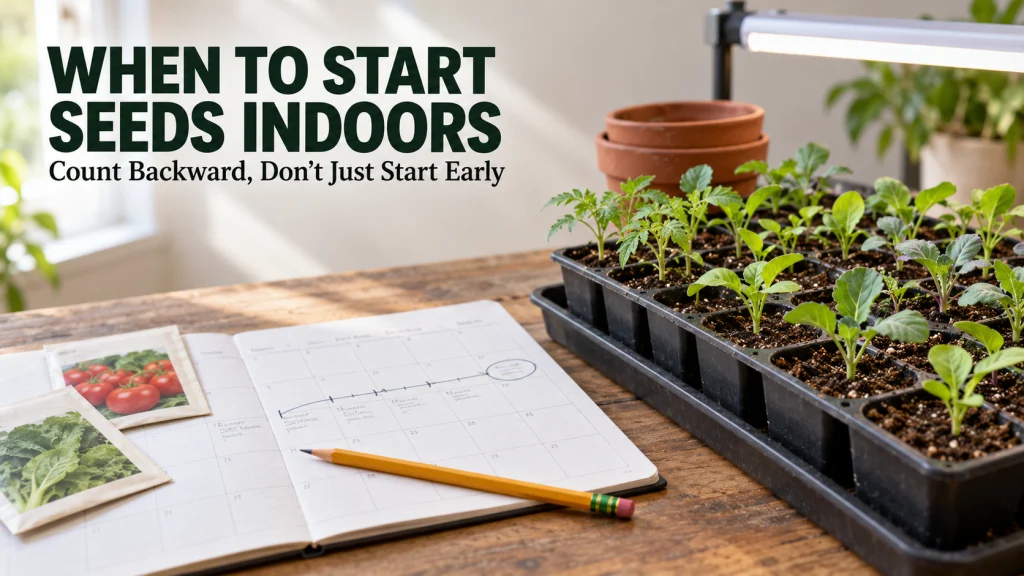
Starting early can create more work than time
When to start seeds indoors sounds like a simple calendar question, but the first mistake is treating earlier as automatically better. A seedling has to keep growing while it waits indoors, so every extra week means more leaf area, more root growth, more watering, and often more room under good light. If outdoor conditions are not ready when the seedling is, the gardener has to carry that extra growth somewhere. What looked like a head start can turn into a holding problem.
University of Maryland Extension notes that timing depends on the recommended outdoor planting point, germination speed, and transplant growth rate, and it warns that sowing too early can produce tall, root-bound plants. That is why this article stays focused on the timing calculation rather than the entire indoor setup. For the broader workflow, use the seed starting process, and for propagation methods beyond indoor seed sowing, see how to propagate plants. The useful question is not how soon you can sow, but how long the seedling can grow indoors before its outdoor target actually arrives.
| Stage | Started too early | Started within the useful window |
|---|---|---|
| Early indoor growth | The seedling may look impressively far ahead. | The seedling is developing at a size the setup can support. |
| Middle of the indoor period | Roots, foliage, and watering demand can begin to outgrow the original space. | Growth remains easier to keep under adequate light with less crowding. |
| Outdoor target approaches | The plant may need potting up, wider spacing, or repeated handling while it waits. | The plant is closer to transplant size when outdoor conditions are suitable. |
| If outdoor conditions are delayed | Every extra indoor week adds more space and root-management pressure. | A modest buffer is easier to absorb without turning the seedling into a long-term houseplant. |
The comparison is not saying that a younger transplant is always superior. It shows why indoor duration is part of the decision rather than a free bonus. A crop with a long recommended indoor period may genuinely need an early sowing, while a fast-growing crop may gain little from extra indoor time. The next step is to identify exactly what outdoor event the timing instruction is counting toward.
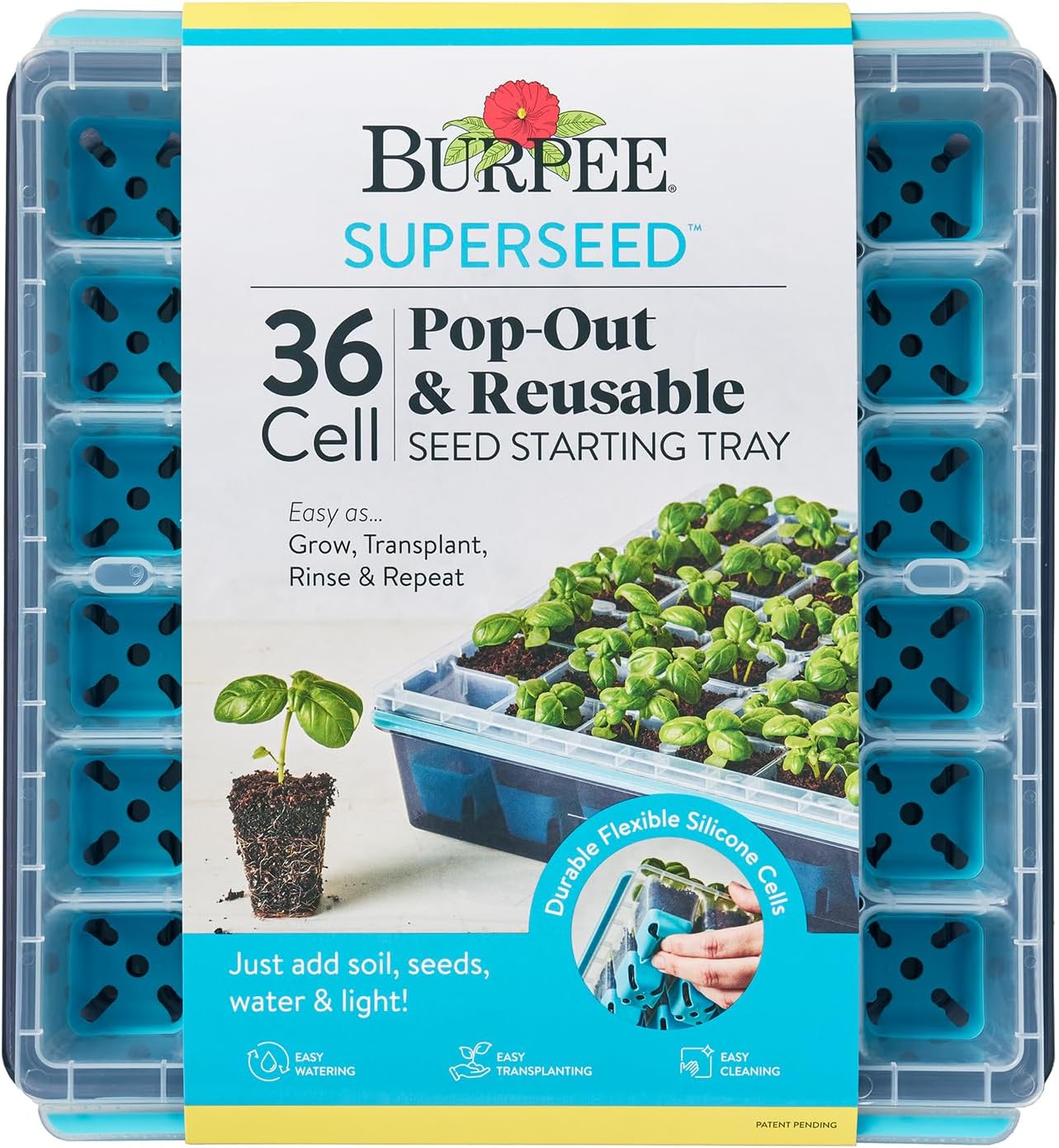
This reusable tray has 36 flexible planting cells for starting seedlings indoors. Molded channels support drainage and airflow around the root zone. The flexible cells help release root balls when seedlings are ready to move on.
Check On AmazonIf you click this link and buy, we earn a commission at no additional cost to you.
Identify the outdoor event the instruction counts toward
Before subtracting any weeks, write down the outdoor target in plain language. It might be the local average last frost, the expected transplant window for a frost-tender crop, or an earlier planting point for a cool-season crop that tolerates colder conditions. Those targets are not interchangeable, so the same backward count can land in the wrong place if the starting reference is vague. The arithmetic only works after the outdoor event is correct.
Do not use USDA Plant Hardiness Zone as a shortcut for that target. The USDA Plant Hardiness Zone Map is based on average annual extreme minimum winter temperature and is primarily a cold-hardiness reference, not a local spring frost calendar. Two gardens can share a hardiness zone while still having different spring timing because local elevation, terrain, and weather patterns differ. For seed starting, use a locally appropriate frost or planting reference and then apply the crop instruction to that reference.
- Write down the outdoor event named by the seed packet or trusted crop guidance.
- Confirm whether that event is a frost reference or an actual transplanting point.
- Use local timing rather than assuming a hardiness zone supplies the answer.
- Keep the crop name attached to the calculation so different crops do not inherit the same schedule by accident.
This is also where cool-season and warm-season crops begin to separate. Iowa State University Extension notes that many frost-tender annuals and vegetables are planted after frost risk has passed, while some cool-season crops can go out earlier. That difference changes the outdoor anchor before any indoor weeks are subtracted. Once the anchor is clear, preserve the wording of the source instead of quietly translating every instruction into “weeks before last frost.”

This digital meter measures soil temperature, moisture, pH, and sunlight intensity. A backlit LCD keeps readings visible while checking indoor or outdoor growing conditions. It can add a local soil-condition check alongside crop-specific frost and transplant guidance.
Check On AmazonIf you click this link and buy, we earn a commission at no additional cost to you.
Preserve whether the source means frost date or transplant date
A timing instruction such as “start indoors six weeks before transplanting” means something different from “start indoors six weeks before the average last frost.” The first instruction already points to an outdoor planting event, while the second points to a climate reference that may or may not be the actual planting time for that crop. Replacing one phrase with the other can shift the whole schedule. Copy the source wording into your notes before doing the subtraction.
This matters most when several references are open at once. One seed packet may use weeks before transplanting, another may use weeks before last frost, and a local Extension page may describe an outdoor planting window for that crop. If those phrases are flattened into a single label, the resulting seed starting dates can look precise while being based on different anchors. Keep each source attached to its own wording, then choose the source that best matches your crop and local conditions.
Key point: Never subtract an indoor growing period until you can finish this sentence: “I am counting backward from the point when this crop is expected to go outside.”
When the source gives a transplant date rather than a frost reference, that transplant date is usually the cleaner anchor because it already incorporates the source’s planting logic. When the source gives only a frost reference, you still need to ask whether the crop actually goes outside at that point. Some crops may be planted earlier under suitable conditions, while frost-tender crops may require warmer soil or air conditions even after the average frost reference has passed. The schedule should follow the crop instruction, not a habit of always subtracting from the same calendar marker.

This set includes three 3 x 5 weatherproof top-spiral notebooks with a universal page pattern. The compact format is easy to keep beside seed packets or a seed-starting station. Use it to copy source wording and date anchors before doing a backward calculation.
Check On AmazonIf you click this link and buy, we earn a commission at no additional cost to you.
Count back the recommended indoor period
Once the outdoor target is clear, the basic calculation is simple: move backward by the indoor growing period given for that crop. UMass Extension describes the same backward-counting approach and shows that indoor periods differ substantially among vegetable groups. That variation is the reason a single universal “start seeds this many weeks before frost” rule does not work well. Use the range or period attached to the crop you are actually growing.
If a packet says to sow indoors a certain number of weeks before transplanting, subtract that period from the transplant target and stop there for the moment. Do not add an extra germination estimate unless the source tells you its indoor period excludes germination. Do not add an extra hardening period until you know whether hardening is already built into the source wording. The goal is a transparent calculation that can be checked, not a stack of buffers that quietly moves sowing earlier and earlier.
| Backward-counting worksheet | What to record | Why it matters |
|---|---|---|
| Outdoor target | The locally appropriate point when this crop is expected to go outside | This is the anchor for the entire calculation. |
| Source wording | Whether the instruction says before frost, before planting, or before transplanting | It prevents different timing references from being treated as equivalent. |
| Indoor period | The crop-specific range or duration supplied by the trusted source | This is the amount subtracted from the outdoor target. |
| Hardening | Whether acclimation time is already included | This prevents accidental double-counting. |
| Sowing window | The resulting earlier-to-later window rather than a single forced point | A range gives room for local conditions and practical scheduling. |
| Indoor capacity | Available light, root volume, shelf space, and ability to pot up if needed | This helps decide where within the window to sow. |
Here is a complete backward-counting example without tying the method to one crop’s universal calendar. Suppose the crop-specific source says to start indoors six to eight weeks before transplanting, and your locally appropriate outdoor target is the point you label as week zero. If that six-to-eight-week instruction already includes hardening, the sowing window is simply week minus eight through week minus six. If the source clearly says hardening is separate and your trusted guidance calls for one additional week of acclimation before transplanting, move the sowing window back one more week, to week minus nine through week minus seven.
The calculation is therefore outdoor target first, then the source-defined indoor range, then a hardening adjustment only when it is genuinely separate. You are not choosing a calendar date from a generic chart, and you are not adding extra time merely because another source uses different wording. Within the resulting window, a gardener with limited shelf and root space might choose the later side, while a setup with enough light and growing room may comfortably use the earlier side. The example works because every subtraction is attached to a named assumption that can be checked later.
Keep the worksheet crop-specific even when two crops happen to land near the same sowing window. That makes later adjustments easier because you can see which assumption belongs to which plant. It also prevents one convenient date from becoming the default for an entire tray of unrelated seedlings. The next calculation is hardening, where double-counting is one of the easiest ways to start earlier than intended.

This hardcover garden journal includes a planting calendar and plant-log pages for tracking seasons and plant progress. Its five-year format keeps repeated scheduling notes in one place. It works well for recording the outdoor target, indoor range, and hardening assumption behind each sowing window.
Check On AmazonIf you click this link and buy, we earn a commission at no additional cost to you.
Add hardening without double-counting it
Indoor-grown seedlings need a gradual transition to outdoor light, wind, and temperature conditions before they are planted in the garden. Iowa State University Extension recommends acclimating seedlings gradually, beginning with gentler outdoor exposure and increasing it over time. That transition belongs in the schedule, but it should not automatically be added as a separate block every time. First check whether your source’s “weeks before transplanting” period already assumes the seedling will be hardened before the final move.
If the source clearly excludes hardening, place the hardening period immediately before the transplant target and count the indoor growing period backward from the start of that transition. If the source already describes the entire interval from sowing through outdoor planting, adding hardening again would shift sowing too early. When the wording is unclear, use the source conservatively instead of inventing precision. A slightly broader sowing window is more honest than pretending an uncertain definition is exact.
Note: Hardening is a transition step, not extra growth time that always belongs on top of the seed packet’s indoor period. Check how the source defines its timing before adding anything.
Think of the schedule as a chain with named stages rather than one giant countdown. The crop grows indoors, then it is gradually acclimated, then it is planted outside when the target conditions are suitable. If the source already bundled two of those stages together, keep them bundled. This simple labeling step prevents an extra week or more from appearing in the schedule just because two resources describe the same transition differently.

This weather-resistant hard plastic tray has a raised edge and is made for indoor or outdoor use. The medium tray measures about 23.75 by 15.5 inches, giving small pots or cell packs a contained surface. It is useful for moving a group of seedlings during a gradual hardening routine.
Check On AmazonIf you click this link and buy, we earn a commission at no additional cost to you.
Keep a window when the source gives a range
When guidance says a crop can be started within a range of weeks, keep both ends of that range instead of immediately converting it to one exact sowing point. A range usually reflects real biological and practical variation, including germination speed, growing temperature, light quality, transplant size, and local planting conditions. Turning it into a single point can create false confidence without improving the decision. Your job is to choose a sensible place inside the range for your setup.
The earlier end makes more sense when you have strong light, enough root volume, reliable space, and a reason to expect the outdoor target will hold. The later end can be safer when indoor space is tight, seedlings grow quickly in your conditions, or outdoor timing is uncertain. That is not a universal rule, because some crops genuinely need the longer end of their recommended indoor period. It is a way to use the range deliberately instead of treating “earlier” as the premium option.
The important boundary is that the range does not authorize unlimited movement. Starting outside the recommended span should have a specific horticultural reason and supporting guidance, not just impatience to begin. If local conditions or the seed packet disagree with a generic chart, favor the crop-specific and locally appropriate source. The next step is to recognize that some crops create indoor pressure much faster than others.

This set includes 100 plastic T-type plant labels measuring 6 x 10 cm. The broad face provides room for crop names and dates. Use one label per crop or tray to mark the selected sowing point within a recommended window.
Check On AmazonIf you click this link and buy, we earn a commission at no additional cost to you.
Adjust for crop-specific growth speed
Different crops should not share one indoor countdown simply because they will eventually occupy the same garden bed. University of Maryland Extension, for example, lists shorter indoor periods for fast-growing cucurbit crops than for slower crops such as peppers and eggplant. That does not mean every variety in those groups follows the same exact schedule, but it demonstrates why crop growth speed belongs in the calculation. Fast growth can turn an unnecessary early start into a root and space problem very quickly.
Use the seed packet or crop-specific Extension guidance as the primary timing reference, then use general charts only as a reasonableness check. Variety, local transplant timing, and the conditions in which seedlings are grown can all shift how quickly a plant reaches a manageable transplant size. If one source says “before transplanting” and another says “before last frost,” reconcile the anchors before comparing the numbers. A range that looks contradictory may simply be counting toward a different outdoor event.
| Crop behavior | Scheduling implication | What to verify |
|---|---|---|
| Fast indoor growth | Avoid adding unnecessary indoor weeks just to feel ahead. | Recommended transplant age or indoor period for the exact crop. |
| Slower indoor development | The earlier side of a recommended range may be justified. | Whether the source includes germination and hardening in its count. |
| Cool-season transplant | The outdoor target may occur before the timing used for frost-tender crops. | Local planting guidance and the crop’s cold tolerance. |
| Frost-tender transplant | The outdoor target depends on suitable warm-season conditions, not merely the desire to plant. | Local frost and planting guidance for the crop. |
Do not read this table as a replacement for crop guidance. It is a check on the logic behind the schedule: slower development can justify more indoor time, while fast growth increases the cost of starting too soon. When a crop page or packet gives a more specific instruction, use that instruction. Once the crop’s growth speed is accounted for, test whether your indoor setup can carry the plant for the chosen duration.

This clip-on grow light uses 6000K full-spectrum white and red LEDs for indoor plants. It offers five dimming levels and automatic timer settings for 4, 8, or 12 hours. Adjustable light duration and intensity help keep seedling conditions more consistent while comparing crop growth rates.
Check On AmazonIf you click this link and buy, we earn a commission at no additional cost to you.
Account for root volume and indoor space if starting early
Starting on the early side of a valid window creates a physical commitment. The seedling will need enough light, root room, air movement, and spacing to keep growing until the outdoor target arrives. A tray that fits comfortably at germination can become crowded once leaves overlap and roots fill the cells. If the setup cannot support that later stage, the earlier sowing point is not truly free.
University of Maryland Extension notes that crowded seedlings can become harder to separate and that plants may need to be moved into larger individual containers when they outgrow the original space. Potting up can solve a real root-volume problem, but it also adds containers, growing medium, shelf area, watering work, and handling. That burden is acceptable when the crop needs the indoor time and the gardener has the capacity. It is harder to justify when the only reason for the extra growth was starting before the useful window.
- Check how many seedlings will still fit under adequate light after their leaves expand.
- Check whether the root volume can support the planned indoor period without forced potting up.
- Leave room to separate seedlings instead of treating every empty cell as capacity that must be filled.
- Assume an outdoor delay is possible, especially when the local target is weather-sensitive.
Indoor capacity can also help you choose among crops when sowing windows overlap. If slow-growing seedlings need the early space more than fast-growing ones do, give the limited shelf area to the crops that benefit from the longer lead time. Fast growers can often wait until their later, crop-appropriate window rather than competing for space prematurely. This turns seed starting into a sequence of manageable batches instead of one crowded event.

This 36-pack includes reinforced clear nursery pots in 3.5, 4, and 5-inch sizes. The pots have drainage holes and are intended for seedlings, propagation, and transplanting. Multiple sizes provide practical options when a seedling needs more root volume before outdoor planting.
Check On AmazonIf you click this link and buy, we earn a commission at no additional cost to you.
Record the window in your planting calendar
Once you have the outdoor target, source wording, indoor period, hardening treatment, and crop-specific range, record the result as a sowing window. Do not save only the final sowing point, because that hides the assumptions that created it. Write enough context to know what you were counting backward from and which source supplied the indoor period. That makes the schedule easier to update when local guidance or your planting plan changes.
A useful entry might include the crop, the outdoor target, the recommended indoor range, whether hardening is included, and your chosen sowing window. Keep the outdoor reference separate from the indoor calculation so you can adjust one without rebuilding the other from memory. For a broader season-level system, the planting calendar guide shows how to organize crop windows across the garden. This article’s job is narrower: make the indoor start window traceable and easy to recalculate.
The record also gives you something useful to compare after the season without pretending one year proves a universal rule. If seedlings were consistently oversized before planting, check whether the outdoor target was delayed, the indoor range was too early for your conditions, or growth was faster than expected. If seedlings were still too small, check whether the chosen point was too late within the allowed range or whether indoor conditions slowed development. Those observations can refine your next schedule while staying inside crop-appropriate guidance.
Keep the adjustment reversible. Moving a future sowing a little within a supported range is a small change; redesigning every crop around one bad season is not. The best record is one that preserves the reason behind each decision so you can change the right variable later. With that in place, seed starting dates become a practical planning tool rather than a collection of disconnected reminders.

This 5 x 7-inch garden logbook has 144 pages for recording plants, notes, and garden results. Its guided log format keeps observations together across the season. It fits the section need to preserve sowing windows and compare later observations without rebuilding the schedule from memory.
Check On AmazonIf you click this link and buy, we earn a commission at no additional cost to you.
Final Thoughts: count backward from the right outdoor target
Start with the crop’s real outdoor target, preserve the wording of the timing source, and then count backward by the recommended indoor period. Add hardening only when it is not already included, keep a range when the guidance gives one, and choose your place in that range with crop growth speed and indoor capacity in mind. This avoids the common trap of starting early simply because there is room on the calendar. The goal is a transplant that reaches the garden at a manageable stage, not the oldest seedling you can keep alive indoors.
When sources disagree, compare what each one is counting toward before deciding that the numbers conflict. Local planting conditions, crop tolerance, and source definitions can explain much of the apparent difference. Keep the calculation with your planting records so it can be adjusted without guessing later. A clear backward schedule is easier to revise than a single sowing date with no record of how it was chosen.

This clear storage box contains 16 individual 4 x 6 inner cases and a carrying handle. The separate cases can keep seed packets grouped without mixing their printed timing instructions. It provides one compact place to store the source material used for later seed-starting calculations.
Check On AmazonIf you click this link and buy, we earn a commission at no additional cost to you.
FAQs
🌱 When should I start seeds indoors?
Start by identifying when that crop is expected to go outside in your location, then count backward by the crop-specific indoor period from a seed packet or trusted horticultural source. Do not use one universal number for every crop.
🗓️ Should I count backward from the last frost or the transplant date?
Use the event named by the source you are following. If it says weeks before transplanting, count from the transplant target; if it says weeks before last frost, keep that frost reference unless crop-specific guidance tells you the actual outdoor planting point is different.
🌤️ Is my USDA hardiness zone enough to set seed starting dates?
No. USDA hardiness zones describe average annual extreme minimum winter temperature, so use local frost and planting guidance for spring timing instead of treating the zone number as a frost calendar.
🪴 What happens if I start seeds too early?
Seedlings may outgrow their cells or shelf space before outdoor conditions are suitable, which can mean crowding, potting up, and more watering and handling. Whether that becomes a problem depends on the crop’s growth rate and the capacity of your indoor setup.
🌬️ Do I add hardening time to every seed starting schedule?
Not automatically. First check whether the source’s indoor period already includes the transition to outdoor conditions; add a separate hardening block only when the source clearly excludes it.
📦 Should every crop use the same weeks-before-transplant number?
No. Crops differ in germination speed, seedling growth rate, transplant tolerance, and outdoor planting conditions, so use crop-specific guidance instead of applying one countdown to the entire garden.
References and Sources
- University of Maryland Extension: Supports crop-specific indoor growing periods, the penalty of sowing too early, and the effect of container space on seedling growth.
- Iowa State University Extension: Supports using crop time from seed guidance, counting backward from the outdoor target, and gradually hardening seedlings before planting.
- UMass Extension: Supports backward counting from outdoor planting and the fact that indoor starting periods vary by crop.
- USDA Plant Hardiness Zone Map: Supports the distinction between winter hardiness zones and the local spring timing needed for seed-starting decisions.